
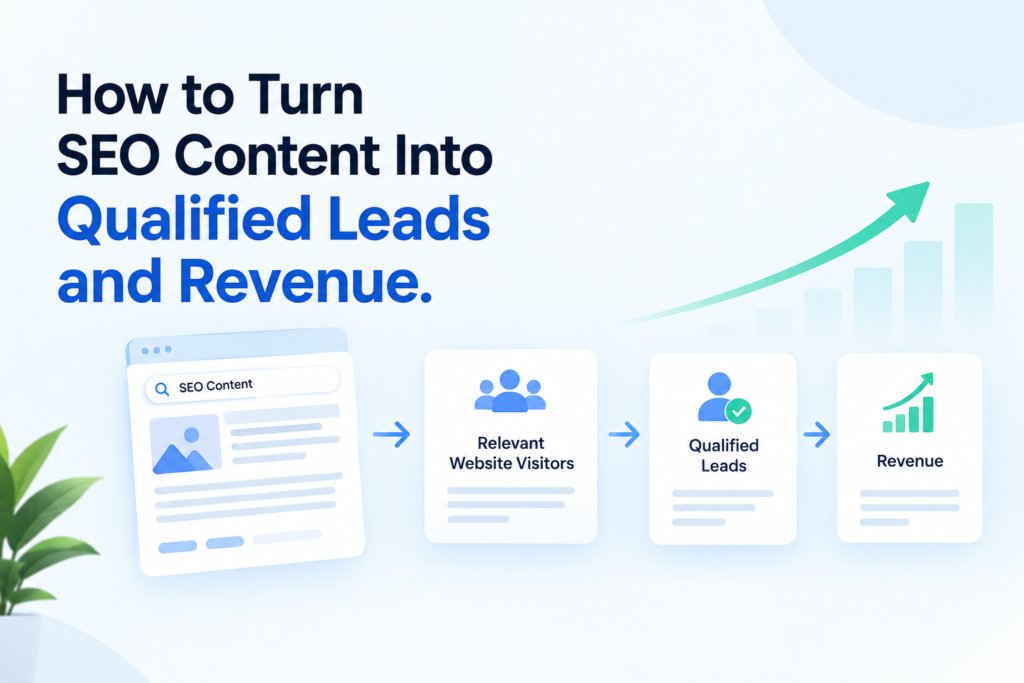
Fintech companies operate in one of the most competitive content marketing environments. Whether a business provides digital lending, payment processing, banking infrastructure, investment management, or financial compliance software, attracting the right audience through organic search is becoming increasingly difficult.
The challenge goes beyond ranking on Google.
Financial services companies must establish credibility, communicate complex information accurately, satisfy regulatory requirements, and convince audiences to trust their products with important financial decisions. At the same time, they compete against established publishers such as NerdWallet, Bankrate, and Investopedia, along with the content teams of major financial institutions.
This makes traditional content marketing strategies less effective.
Many fintech companies respond by publishing more educational articles, targeting keywords with high search volumes, and measuring success through organic traffic. Although this approach can generate website visits, it often fails to attract people who are actively looking for a financial product or service.
The problem becomes more significant when content marketing is expected to contribute to sales pipeline and revenue.
A company selling payment processing software does not need thousands of visitors searching for the definition of a payment gateway. It needs businesses evaluating payment processing solutions. A digital lending company does not just need readers learning about property financing. It needs borrowers comparing lenders and looking for financing options.
These audiences have different levels of buying intent, and the content strategy should reflect that difference.
At Pro Start Marketing, we believe fintech content marketing should begin with the audience’s problems and purchasing decisions rather than search volume alone.
Piyush Choudhary, founder of Pro Start Marketing, brings more than five years of experience in content marketing and SEO. His approach focuses on connecting search intent, useful content, and business outcomes rather than treating publishing volume as the primary measure of success.
For fintech companies, this means building a content program that attracts potential buyers, demonstrates genuine product expertise, supports purchasing decisions, and generates measurable business opportunities.
In this article, we explain five important steps for developing a fintech content marketing strategy that supports organic growth and revenue generation.
We will cover:
- How to identify high buying intent keywords that fintech companies can realistically target.
- Why expert interviews produce better fintech content than desk research alone.
- How to discuss financial products and services without creating unnecessary compliance problems.
- How to improve visibility in AI search platforms such as ChatGPT, Perplexity, and Google AI Overviews.
- How to connect content performance with qualified leads, applications, and revenue.
1. Prioritize High Buying Intent Keywords Instead of Chasing Search Volume
Most fintech content strategies begin with keyword research.
A marketer opens Ahrefs or Semrush, enters a few industry related terms, reviews the search volume, and builds a content calendar around the keywords that appear most attractive.
This is a familiar approach, but it creates a problem.
The keywords with the highest search volumes are often the most competitive and least connected to immediate purchasing decisions.
For example, consider a fintech company offering digital payment infrastructure to SaaS businesses.
Its content team might target keywords such as:
- What is payment processing?
- What is a payment gateway?
- How do credit cards work?
- What is a merchant account?
- What is financial technology?
These topics attract people interested in understanding financial concepts. However, many of those visitors are students, researchers, or professionals looking for general information.
They may never become customers.
Meanwhile, someone searching for the best payment processing platform for SaaS companies is much closer to selecting a provider.
The second searcher already understands the problem. They are evaluating potential solutions and looking for a product that meets their requirements.
This distinction is the foundation of Pain Point SEO.
Rather than prioritizing keywords based on search volume, Pain Point SEO focuses on the problems people are trying to solve and the products or services they are considering.
For fintech companies, this means giving priority to keywords that indicate a purchasing decision.
Here are six keyword categories worth considering.
Category Keywords
Category keywords are among the most valuable opportunities for fintech companies because they indicate that the searcher is actively looking for a particular product or service.
These searches commonly follow patterns such as:
- Best [product category] for [audience].
- Top [financial service] platforms.
- Best [software category] for [specific business need].
- [Product category] providers for [industry].
For example, a digital lending company might target:
- Best DSCR lenders for rental property investors.
- Top hard money lenders for fix and flip projects.
- Best commercial real estate lenders.
A payment processing company could target:
- Best payment processing platforms for SaaS companies.
- Top B2B payment automation software.
- Best payment processors for subscription businesses.
Similarly, a banking infrastructure provider could target:
- Best KYC compliance software.
- Top banking as a service platforms.
- Best banking infrastructure providers for fintech startups.
These keywords attract people who are already exploring available solutions.
They are not simply learning about an industry. They are trying to identify the right provider.
Grow and Convert reports that its bottom of funnel content converts into qualified leads at approximately 25 times the rate of top of funnel content across its client data.
Its reported comparison shows a 4.78% conversion rate for bottom of funnel content compared with 0.19% for top of funnel content.
Although actual conversion rates vary by business, audience, and product, the difference illustrates why keyword intent deserves more attention than search volume alone.
For fintech marketers, category keywords should be among the first opportunities to evaluate.
Comparison Keywords
Comparison keywords indicate that a potential customer is evaluating different products or considering alternatives to an existing provider.
These searches commonly include:
- [Competitor] alternatives.
- [Brand] vs [Brand].
- Companies like [competitor].
- Best alternatives to [product].
For example, a payment processing company competing with Stripe could target:
- Stripe alternatives for high risk merchants.
- Stripe vs [brand] for subscription billing.
- Best alternatives to Stripe for SaaS businesses.
A lending company could target:
- [Competitor] alternatives for investment property loans.
- DSCR lender comparison.
- Hard money lender comparison for real estate investors.
Comparison content is particularly valuable in financial services because choosing the wrong provider can have long term financial consequences.
A business selecting a payment processor needs to consider transaction fees, settlement times, integration requirements, payment acceptance rates, and chargeback management.
A real estate investor choosing a lender may need to evaluate interest rates, loan terms, prepayment penalties, qualification requirements, and closing timelines.
These decisions involve more than comparing a few features.
Potential customers need detailed information that helps them understand the differences between providers and determine which solution fits their circumstances.
This creates an opportunity for fintech companies to publish genuinely useful comparison articles.
Instead of producing a basic feature table, explain the practical differences between products. Discuss pricing structures, integration requirements, eligibility conditions, limitations, and the situations in which one provider might be a better choice.
A comparison article should help readers make an informed decision, even when that decision involves choosing a competitor.
That level of transparency builds credibility and gives potential customers a stronger reason to trust your recommendations.
Use Case Keywords
Use case keywords describe a specific situation in which someone needs a product or service.
Unlike general educational searches, these keywords indicate that the searcher has a particular task or business requirement.
They often follow patterns such as:
- How to [complete a specific financial task].
- [Product category] for [specific situation].
- How to use [financial solution] for [business requirement].
For a lending company, examples include:
- How to finance a short term rental property.
- DSCR loans for multifamily properties.
- Financing options for real estate investors.
For a payment processing company:
- How to automate invoice reconciliation.
- How to accept ACH payments for recurring billing.
- Payment processing for subscription businesses.
For an accounting or financial management platform:
- How to automate expense reconciliation.
- How to track expenses across multiple business entities.
- How to manage payments from multiple business accounts.
These topics work because they connect a reader’s immediate requirement with a potential product solution.
A person searching for ways to automate invoice reconciliation may be struggling with manual processes, accounting errors, or time consuming financial operations.
An article explaining how invoice reconciliation works can introduce the different approaches available and demonstrate how software can simplify the process.
The product should appear where it naturally answers the reader’s problem.
Template and Checklist Keywords
Template and checklist keywords indicate that someone wants a practical resource to complete a particular task.
They commonly include searches such as:
- [Financial document] template.
- [Business process] checklist.
- [Financial calculation] calculator.
- [Compliance process] worksheet.
Examples for fintech companies include:
For lending businesses:
- DSCR calculation spreadsheet.
- Rental property cash flow template.
- Real estate loan comparison worksheet.
For compliance software providers:
- KYC onboarding checklist.
- AML compliance audit template.
- Customer verification checklist.
For payment processing companies:
- Payment reconciliation template.
- Chargeback dispute letter template.
- Payment processing fee calculator.
These resources offer immediate value to readers.
They also create natural opportunities to demonstrate how a fintech product can automate work that would otherwise require manual calculations, spreadsheets, or repetitive administrative tasks.
For example, a payment reconciliation template can help a business understand the process. The accompanying article can explain how payment reconciliation software automates matching transactions, identifying discrepancies, and maintaining accurate financial records.
The content provides a useful resource while showing where the product fits into the workflow.
Pain Point Keywords
Pain point keywords describe a specific problem or frustration.
The searcher may not know which product to choose yet, but they understand that something is not working.
These keywords often follow patterns such as:
- Why does [financial problem] happen?
- How to fix [financial issue].
- How to reduce [business cost].
- Why is [financial process] taking so long?
Examples include:
For payment processing companies:
- How to reduce payment processing fees.
- How to lower chargeback rates.
- Why are online payments failing?
- How to reduce failed subscription payments.
For lending companies:
- Why do hard money loans take so long to close?
- How to get approved for an investment property loan without a W2.
- Why was my commercial property loan rejected?
For financial management platforms:
- Why does invoice reconciliation take so long?
- How to reduce accounting errors.
- How to manage expenses across multiple business entities.
These topics allow fintech companies to demonstrate that they understand the problems their customers face.
A useful article should explain why the problem occurs, identify its underlying causes, discuss possible solutions, and show where a product can help.
The connection between the problem and the product should be clear.
Jobs to Be Done Keywords
Jobs to Be Done keywords focus on the outcome someone wants to achieve rather than the product they need.
The searcher has a goal but may not have decided which tool or provider can help them accomplish it.
Examples include:
- How to build a rental property portfolio with no money down.
- How to get paid faster as a freelancer.
- How to manage finances across multiple businesses.
- How to improve cash flow for a growing SaaS company.
- How to simplify international business payments.
These searches capture people who have committed to achieving a specific result but may still be exploring their options.
For fintech companies, this creates an opportunity to connect a broader business objective with a relevant financial solution.
For example, an article about improving cash flow for a SaaS company can discuss subscription billing, payment collection, failed transactions, and payment reconciliation.
A payment platform that addresses these challenges can become a natural part of the discussion.
The key takeaway: Do not build your fintech content calendar around the keywords that generate the most searches. Build it around the searches that attract people most likely to need your product.
2. Produce Fintech Content Through Expert Interviews, Not Desk Research
One of the biggest problems with fintech content is that much of it sounds the same.
A writer receives a keyword, searches Google, reads the top ranking articles, collects information from several sources, and creates another article covering the same points.
The result is content that may be technically correct but offers little new value.
We call this the research only approach to content production.
It creates a particular problem in financial services because the target audience often understands the subject better than the person writing about it.
Consider a CFO evaluating payment infrastructure.
This person may have years of experience dealing with interchange fees, PCI compliance, failed payment recovery, and financial reconciliation.
A general article explaining what payment processing is will not provide much value to someone with that level of experience.
Similarly, a real estate investor comparing DSCR lenders may already understand debt service coverage ratios, prepayment penalties, loan structures, and qualification requirements.
A compliance officer evaluating KYC automation software can quickly recognize whether an article was written by someone who understands actual compliance workflows.
If the content only repeats information available across other websites, it gives readers little reason to trust the company publishing it.
The solution is to bring internal expertise into the content production process.
Why Desk Research Alone Is Not Enough
Research is an important part of content writing. Writers need to understand the subject, verify information, examine search intent, and identify what readers expect from an article.
However, research should provide the foundation, not the entire substance.
When writers depend exclusively on existing search results, they tend to reproduce the same explanations, examples, and arguments.
This creates several problems:
First, the content lacks original insights. Readers can find almost identical explanations on competing websites.
Second, it fails to communicate the company’s actual expertise. The article does not reflect what the business has learned from serving customers.
Third, it creates a weak connection between the content and the product. The writer understands the general topic but may not understand how the company’s solution addresses specific customer problems.
For fintech companies, these limitations can damage credibility.
Financial decisions involve trust. Readers want information from businesses that understand the practical challenges of their industry.
Interview People Who Actually Understand the Product
Instead of relying on desk research alone, build articles around interviews with internal subject matter experts.
These interviews can include people from different departments, depending on the subject.
For a lending company, useful interview sources include:
- Head of originations.
- Loan officers.
- Underwriting specialists.
- Customer success managers.
- Product managers.
A head of originations can explain the common mistakes borrowers make during applications.
An underwriting specialist can discuss why certain loan structures get rejected and which factors influence approval decisions.
A loan officer can explain how property type, rental income, seasoning requirements, and borrower documentation affect the lending process.
These details make the content more practical than a general explanation of DSCR lending.
For payment processing companies, useful interview sources include:
- Solutions engineers.
- Account executives.
- Product managers.
- Customer success leads.
- Technical integration specialists.
A solutions engineer may explain the integration challenges enterprise customers experience.
An account executive may understand the objections buyers raise when comparing payment providers.
A customer success manager may know which payment problems appear most frequently after implementation.
These insights can help writers produce content that reflects real customer experiences.
Find Originality Nuggets During Interviews
The most valuable information from an expert interview often comes from specific examples, observations, and details that would be difficult to discover through ordinary online research.
We refer to these as originality nuggets.
For example, an educational article about DSCR lending might explain what a DSCR ratio is and describe common qualification requirements.
An interview with a loan officer could reveal much more.
The expert might explain why a 1.25x DSCR requirement can have different implications for a short term rental property compared with a long term rental.
They might discuss how seasoning requirements affect a borrower’s financing timeline or explain which property structures are more likely to receive approval under current lending conditions.
These details give the article practical depth.
They also help readers understand the subject from the perspective of someone who works with these financial products regularly.
For payment processing content, an expert might explain why a business experiences repeated payment failures despite having sufficient customer funds.
A product specialist could describe how retry logic, payment routing, and transaction monitoring influence payment recovery.
A compliance professional might explain why certain customer verification processes require additional documentation.
These are the kinds of insights that differentiate expert led content from generic articles.
Match the Interviewee to the Article Topic
Not every internal expert is suitable for every article.
The person you interview should understand the specific problem, product, or decision covered by the content.
A useful starting point is:
| Content type | Best interview sources |
|---|---|
| Category and comparison articles | Account executives and sales engineers |
| Use case and pain point articles | Product managers and customer success leads |
| Compliance related articles | Compliance specialists |
| Lending and underwriting articles | Loan officers and underwriting teams |
| Technical payment articles | Solutions engineers and technical specialists |
Sales teams are particularly valuable for category and comparison content because they regularly hear competitive objections.
They understand what prospects ask, which alternatives they consider, and what factors influence purchasing decisions.
Product managers and customer success teams are better sources for explaining how a product solves specific problems in practice.
Compliance specialists should be involved whenever content discusses regulatory requirements or sensitive financial claims.
Expert Interviews Also Help With Compliance
There is another important benefit of interviewing internal experts.
Fintech content frequently goes through compliance review before publication.
When an external writer researches a financial product independently, they may misunderstand its terms, describe an inaccurate rate structure, or make claims that require additional verification.
For example, an article about lending products might compare rates incorrectly.
An article about an investment platform might include performance claims that conflict with applicable SEC requirements.
These mistakes create unnecessary revisions and delay publication.
Building content around internal experts reduces this risk because the original information comes from people who understand the product and its regulatory boundaries.
Compliance teams can review the claims against the company’s actual policies, documentation, and approved messaging.
This does not eliminate the need for compliance review. However, it can make the process more efficient and reduce avoidable rewrites.
The key takeaway: Research tells you what is already available online. Expert interviews reveal what your company knows that competitors cannot easily reproduce.
3. Sell Your Financial Product in Every Relevant Article Without Creating Compliance Problems
Many fintech companies are hesitant to discuss their products in blog content.
Their marketing teams may worry that mentioning specific features will make articles appear too promotional.
Compliance teams may also prefer general educational content because it reduces the risk of inaccurate or unsupported claims.
As a result, companies often publish articles that explain financial concepts without showing how their products solve the problems discussed.
This creates a missed opportunity.
Imagine someone searching for the best payment processing platform for SaaS companies.
They land on an article published by a payment processing company.
The article explains payment processing, discusses industry challenges, and compares different approaches. However, it never explains the company’s product, its capabilities, or how it addresses the reader’s requirements.
The visitor finishes reading without understanding why the company should be considered.
The article may generate organic traffic, but it does little to move the reader toward a purchasing decision.
High intent content should connect the reader’s problem with a relevant solution.
That solution may be your product.
Being Specific Is Better Than Being Promotional
The hesitation around product mentions often comes from the belief that selling requires exaggerated marketing language.
It does not.
Fintech companies should avoid unsupported statements such as:
- We offer the lowest rates in the industry.
- Our platform is the fastest payment solution available.
- We provide the best lending products on the market.
- Our investment platform guarantees superior returns.
These claims create compliance concerns because they require evidence and, in some cases, may be inappropriate under applicable regulations.
However, avoiding all product details is not the answer.
Instead, explain specific features, product conditions, technical capabilities, and measurable benefits that the company can substantiate.
For example, rather than claiming that a lending platform offers industry leading rates, explain the actual rate structures available for different loan types.
Instead of claiming that a payment processor is faster than every competitor, describe the technical architecture that supports its settlement process and explain the implications for a customer’s cash flow.
Rather than saying a KYC platform makes compliance effortless, explain the specific verification steps it automates and how those workflows affect customer onboarding.
Specific information helps readers understand the product.
It also gives compliance teams clear claims to verify.
Use Verifiable Product Claims
Every product related statement should be supported by accurate information.
Consider a lending company that offers DSCR loans.
A general statement such as “We provide the best DSCR loans for investors” is difficult to substantiate.
A more useful statement might explain the minimum DSCR requirement, whether tax returns are required, the available loan structures, and the types of properties the company considers.
Similarly, a payment processor should explain its actual transaction capabilities, supported payment methods, settlement conditions, integration options, and documented uptime figures where appropriate.
A compliance software provider can describe the specific KYC steps its platform automates rather than making broad promises about simplifying regulatory compliance.
This approach creates a stronger connection between product information and customer requirements.
It also makes content easier to review because compliance teams can evaluate specific statements against existing documentation.
Of course, every financial product claim must still be checked against the applicable regulatory requirements, internal policies, and approved disclosures.
Introduce Products Where They Naturally Answer the Question
Product mentions should not interrupt the reader’s experience.
They should appear in the section where the reader expects to find a relevant solution.
For example, consider an article targeting the keyword “best DSCR lenders for rental properties.”
The company can appear as one entry in the comparison alongside other lenders.
That entry should include relevant details such as lending criteria, available property types, loan terms, and other verified information.
The same principle applies to comparison articles.
If the article discusses alternatives to a particular payment processor, explain how your platform compares in terms of pricing, integrations, payment methods, and supported business models.
For a use case article targeting “how to finance a short term rental property,” introduce the company’s lending product when discussing the available financing options.
For a pain point article targeting “why do hard money loans take so long to close,” discuss the common reasons for delays before explaining which parts of the process your product or service addresses.
This approach makes product information relevant rather than promotional.
The reader receives an answer to the original question while learning how the company can help.
Give Readers a Logical Next Step
A product mention should also connect with an appropriate call to action.
Not every reader is ready to speak with sales immediately.
Someone comparing payment processors may want to review pricing.
A business evaluating lending options may want to check eligibility.
A reader exploring KYC software may want to see how the platform works.
The call to action should match the intent of the article.
For example:
- Category article: Explore the platform’s features or request a product demonstration.
- Comparison article: Review pricing, integrations, and product capabilities.
- Use case article: See how the platform supports the specific workflow.
- Template article: Download the resource or explore the automation features.
- Pain point article: Learn how the product addresses the problem.
The objective is to help readers move from information gathering to solution evaluation.
The key takeaway: Compliance does not require fintech companies to remove their products from content. It requires them to communicate accurately, substantiate claims, and involve the appropriate reviewers.
4. Optimize Fintech Content for AI Search Visibility
The way people discover financial products is changing.
Traditional search engines remain important, but users are increasingly asking AI platforms such as ChatGPT, Perplexity, and Google AI Overviews to research products, compare providers, and identify potential solutions.
For fintech companies, this creates another opportunity to reach potential customers.
However, many businesses misunderstand what improving AI search visibility actually requires.
Some advice suggests that companies need an entirely separate content strategy for AI search.
Others focus heavily on technical tactics, including llms.txt files, short answer sections, and content written specifically for AI crawlers.
These approaches can distract marketers from a more important question:
Does your company publish the information AI search platforms need when recommending financial products and services?
Why Traditional SEO Still Matters for AI Search
AI search platforms use different methods to discover and retrieve information.
Depending on the platform and query, they may draw on search indexes, retrieved web pages, third party sources, and other information available to them.
Traditional search visibility can therefore play an important role in AI discovery.
Consider someone asking ChatGPT:
“What are the best DSCR lenders for investment properties?”
This is different from asking:
“What is a DSCR loan?”
The first query requires a recommendation.
The AI platform needs information about actual lenders, their products, eligibility requirements, and the situations in which they may be suitable.
The second query is primarily educational.
An AI platform can explain what a DSCR loan means using general financial information. It may not need to recommend a particular company.
This distinction matters.
If a fintech company publishes only general educational articles, it may have little relevant content to support AI recommendations for its products.
However, if it publishes detailed category pages, comparison articles, product evaluations, and use case content, it has more opportunities to become a relevant source when users ask purchasing related questions.
Traditional SEO and GEO should therefore work together.
Prioritize Bottom of Funnel Content for AI Recommendations
The keyword categories discussed earlier are also important for AI search visibility.
Category queries help AI platforms identify potential providers.
Comparison queries provide information about differences between competing products.
Use case queries explain which products are relevant to specific situations.
Pain point queries connect customer problems with potential solutions.
These are the types of searches where a company can become part of the recommendation process.
Consider the difference between two queries.
Educational query: What is a DSCR loan?
An AI platform can explain the concept, its calculation, and common qualification requirements without recommending a specific lender.
Commercial query: What are the best DSCR lenders for multifamily properties?
An AI platform needs information about actual lenders and their suitability for multifamily properties.
Content that evaluates lenders, explains eligibility requirements, and compares relevant product features becomes much more useful for answering the second query.
This is why bottom of funnel content deserves a central position in fintech GEO strategies.
A Practical Example From Financial Services
Grow and Convert shared an example involving Constitution Lending, a financial services company.
According to its published article, Constitution Lending has a domain authority below 40. This makes competing with major financial publishers for broad educational keywords difficult.
Instead of concentrating on those highly competitive topics, the content strategy focused on bottom of funnel keywords across its lending, investing, and real estate business lines.
Grow and Convert reports that Constitution Lending subsequently appeared in top AI search recommendations for more than 50 bottom of funnel queries.
This example illustrates an important point.
A company does not necessarily need to outperform major financial publishers across every broad educational topic to become visible in AI recommendations.
It can focus on specific commercial queries where its expertise and products are relevant.
It is also important to distinguish this reported client result from a universal guarantee. AI visibility depends on the query, platform, available sources, competition, and how the information is retrieved.
Build Content That Helps AI Platforms Understand Your Product
For fintech companies, AI search visibility depends partly on how clearly their products and expertise are represented online.
Your content should explain:
- What your product does.
- Which businesses or customers it serves.
- Which financial problems it solves.
- What makes its features relevant.
- How it compares with available alternatives.
- Which use cases it supports.
- What limitations or eligibility requirements apply.
For example, a company offering payment infrastructure for SaaS businesses should publish content that explains its support for recurring billing, payment reconciliation, subscription management, and other relevant capabilities.
A lending company should provide clear information about its lending criteria, property types, loan structures, and qualification requirements.
A KYC software provider should explain its verification workflows, supported processes, and integration capabilities.
The more accurately these details are communicated across relevant pages, the easier it becomes for potential customers and information retrieval systems to understand the business.
Avoid Treating Every AI Optimization Tactic as a Priority
There is considerable discussion around technical GEO tactics.
Some recommendations focus on adding llms.txt files, creating dedicated takeaway sections, or shortening articles to make them easier for AI systems to process.
These tactics should not replace a strong content strategy.
For fintech companies, the priority should be publishing genuinely useful information that addresses commercial search intent.
An article that thoroughly compares lending providers, explains product eligibility, and answers important buyer questions is more valuable than a short article written simply to satisfy an assumed AI preference.
The same applies to traditional SEO.
Strong technical foundations, accessible content, relevant internal links, and clear website architecture matter. However, they cannot compensate for content that does not answer the questions potential customers are asking.
Measure AI Search Visibility Alongside Traditional SEO
Fintech marketers should monitor how their brands appear across relevant AI platforms.
For example, a lending company could regularly test queries such as:
- Best DSCR lenders for rental property investors.
- Top lenders for short term rental properties.
- Best financing options for multifamily properties.
- DSCR lenders with flexible qualification requirements.
A payment processing company could test:
- Best payment processors for SaaS companies.
- Stripe alternatives for subscription businesses.
- Best payment automation platforms for B2B companies.
Track whether your company appears, how accurately its products are described, which competitors are mentioned, and which sources support the recommendations.
These observations can help identify content gaps and opportunities.
The key takeaway: AI search visibility should not be treated as a completely separate marketing discipline. Building relevant, high quality content for commercial queries can strengthen both traditional organic search and the chances of appearing in AI generated recommendations.
5. Set Up Conversion Tracking That Connects Content Marketing to Revenue
One of the biggest challenges in fintech content marketing is proving its contribution to business growth.
Many companies report performance through metrics such as:
- Organic website traffic.
- Keyword rankings.
- Number of published articles.
- Time spent on a page.
- Email subscriptions.
- Whitepaper downloads.
These metrics provide useful information about content performance.
However, they do not automatically demonstrate whether content is generating qualified leads, loan applications, product demonstrations, or funded accounts.
This creates a gap between marketing activity and business results.
A content team might report that organic traffic increased by 40% during a quarter.
But if the number of qualified leads remained unchanged, leadership may question whether the additional traffic contributed anything meaningful to the business.
The problem is not necessarily the content itself.
The problem may be that the company has no reliable way to connect content interactions with conversions.
Track What Happens After Someone Reads an Article
A fintech content strategy should be built around measurable customer actions.
Consider a lending company publishing an article targeting “best DSCR lenders for rental properties.”
A visitor reads the article, clicks through to an application page, completes the form, and eventually receives loan approval.
The company should be able to identify the article that contributed to that application.
Similarly, a payment processing company might publish a comparison article about payment providers.
A visitor reads the article, clicks a call to action, requests a product demonstration, and eventually becomes a customer.
Tracking should connect these interactions.
Without this information, marketers may know which articles generate traffic but remain uncertain about which ones generate business opportunities.
Use UTM Parameters to Track Content Interactions
UTM parameters help identify the source of website traffic and marketing interactions.
They can be added to relevant links to provide additional information about where visitors came from and which campaigns or content initiatives influenced their journey.
For example, a fintech company can use consistent tracking parameters across internal campaign links and relevant promotional links.
The objective is to understand how readers move from an article toward a conversion page.
Internal tracking should be implemented carefully to avoid overwriting original acquisition information or disrupting existing analytics attribution.
A consistent naming structure also makes reporting easier.
Configure Conversion Tracking in Google Analytics
Google Analytics or another analytics platform can help track important actions on a website.
For fintech companies, these events may include:
- Product demonstration requests.
- Loan application submissions.
- Account registration.
- Contact form submissions.
- Pricing page interactions.
- Consultation bookings.
- Qualified lead submissions.
Not every action has the same business value.
For example, someone downloading a general educational guide is different from someone completing a loan application.
Both actions can be tracked, but they should not be treated as equivalent conversions.
Define the actions that matter to the business and configure analytics accordingly.
Connect Analytics With Your CRM
Analytics can show what visitors do on your website.
A customer relationship management system can help track what happens after someone becomes a lead.
Connecting these systems allows marketing teams to follow the customer journey beyond the initial website interaction.
For example, a payment processing company might track:
- A prospect visits a comparison article.
- The prospect clicks a product demonstration CTA.
- The prospect submits a form.
- The sales team qualifies the lead.
- The prospect enters the sales pipeline.
- The prospect becomes a customer.
The content team can then examine which articles contributed to qualified opportunities and closed business.
For a lending company, the journey might include an article visit, loan application, underwriting review, approval, and funded account.
The specific stages will depend on the business model.
Identify Which Content Categories Generate the Best Results
Once conversion tracking is working, content performance becomes much easier to evaluate.
Imagine a payment processing company has published three types of articles.
| Content category | Monthly visitors | Conversion rate |
|---|---|---|
| Educational article | 5,000 | 0.2% |
| Comparison article | 1,000 | 8% |
| Category article | 1,500 | 4% |
In this illustrative example, the educational article attracts the most visitors.
However, the comparison article generates a much higher conversion rate.
This changes how the marketing team should evaluate its content investment.
Instead of assuming that the article with the most traffic is the most valuable, the team can identify which topics attract people who are more likely to become customers.
The company can then prioritize similar commercial topics, improve underperforming articles, and allocate resources based on actual results.
These figures are illustrative and should not be interpreted as industry benchmarks.
Measure Cost Per Lead and Pipeline Contribution
Fintech companies should go beyond counting conversions.
They should also evaluate the cost and quality of the leads generated through content.
Useful metrics include:
- Organic qualified leads.
- Cost per qualified lead.
- Demo requests from organic content.
- Loan applications from organic content.
- Application approval rates.
- Funded accounts.
- Pipeline value influenced by content.
- Revenue attributed to content.
For example, an article that generates 20 qualified leads may be more valuable than another article generating 200 unqualified visitors.
The actual value depends on the conversion rate, customer acquisition cost, sales cycle, and lifetime value of the customers.
This is particularly important in fintech because the customer journey can be longer and more complex than a simple online purchase.
A business evaluating a payment infrastructure provider may require technical discussions, compliance reviews, and internal approval before signing a contract.
A borrower may need to submit documents and complete underwriting before a loan is funded.
Content attribution should account for these stages.
It is also important to distinguish first touch, last touch, and influenced attribution. A single article may introduce a company, while another page helps the prospect make the final decision.
No single attribution model captures every interaction perfectly.
However, a consistent tracking system provides much better information than relying exclusively on traffic reports.
Use Conversion Data to Improve Your Content Strategy
Tracking is valuable because it makes future content decisions more informed.
Suppose a company discovers that comparison articles consistently generate more qualified leads than broad educational articles.
It can prioritize additional comparison topics.
If certain product pages receive significant traffic but few demo requests, the company can investigate whether the content answers buyer questions or whether the next step is unclear.
If readers regularly visit an article about payment failures before requesting a demonstration, the marketing team can examine whether that topic deserves additional investment.
This information also helps marketing teams communicate with compliance departments.
Instead of arguing that product mentions should be allowed because they improve content quality, marketers can demonstrate whether articles containing specific, verified product information generate more meaningful business opportunities.
The discussion becomes more practical.
How can the company communicate product capabilities accurately while remaining within its regulatory boundaries?
That is a more productive question than avoiding product information altogether.
The key takeaway: Traffic is an indicator of reach, not proof of revenue. Fintech companies should connect content interactions with qualified leads, applications, sales pipeline, and funded accounts wherever their systems allow.
Building a Fintech Content Marketing Strategy That Supports Long Term Growth
The five steps discussed above work best as parts of a single strategy.
Keyword research identifies the searches that matter.
Expert interviews bring original knowledge into the content.
Accurate product mentions connect customer problems with relevant solutions.
SEO and GEO help potential buyers discover the content.
Conversion tracking reveals whether those efforts generate business results.
When these activities work together, content marketing becomes more than a publishing function.
It becomes a measurable acquisition channel.
For fintech companies, this is particularly important because financial products require trust, expertise, and careful communication.
Publishing hundreds of general educational articles may increase website activity, but it does not automatically create demand for your product.
A smaller collection of well researched, commercially relevant articles may attract a more valuable audience.
Start With the Keywords Closest to a Purchasing Decision
Do not begin by trying to cover every topic in your industry.
Identify the products and services your company wants to sell.
Then research how potential customers search for those solutions.
Look for category keywords, comparison queries, use cases, templates, pain points, and Jobs to Be Done searches.
Prioritize topics that connect directly with your product and sales process.
Build a Repeatable Expert Interview Process
Identify the people inside your company who understand your customers and products.
Create a process for interviewing them before writing important articles.
Collect specific examples, customer objections, product limitations, technical details, and practical observations.
These insights should become part of your content production process rather than remaining inside individual departments.
Involve Compliance Early
Compliance should not become an afterthought.
Identify which topics and product claims require additional review.
Use approved documentation and internal experts to verify sensitive information.
A clear review process can help prevent avoidable revisions and support more consistent publishing.
Create Content for Both Traditional and AI Search
Build articles around commercial search intent.
Publish useful comparisons, category pages, and detailed use case content.
Make product information clear and accurate.
Monitor how your company appears in relevant AI recommendations, and use those observations to identify missing information and content opportunities.
Measure the Business Impact
Set up analytics and CRM tracking before publishing large volumes of content.
Define what counts as a qualified lead and which conversions matter to the business.
Review content performance based on lead quality, pipeline contribution, and revenue rather than traffic alone.
This allows your content strategy to improve based on actual customer behavior.
How Pro Start Marketing Approaches Fintech Content Marketing
At Pro Start Marketing, we believe effective content marketing starts with understanding the business behind the content.
A fintech company does not need articles simply because competitors are publishing them.
It needs content that attracts the right audience, answers important purchasing questions, establishes credibility, and helps potential customers evaluate its products.
Our approach brings together content marketing, SEO, and generative engine optimization to support these objectives.
Piyush Choudhary, founder of Pro Start Marketing, has more than five years of experience in content marketing and SEO. His approach emphasizes understanding search intent, researching complex subjects, and creating content that serves a clear business purpose.
For fintech businesses, this means focusing on five areas.
Commercial keyword research: We identify high intent keywords that connect with your financial products, services, and customer requirements.
Expert driven content: We use insights from people who understand your products, customers, and industry to create content with practical depth.
Product focused storytelling: We communicate relevant product features and capabilities naturally, using accurate and verifiable information.
SEO and GEO optimization: We build content around the questions people use to evaluate financial solutions, helping businesses strengthen their visibility across traditional and AI search platforms.
Performance measurement: We focus on meaningful conversions and business outcomes so content performance can be evaluated beyond website traffic.
Our objective is to help fintech companies build a content marketing program that supports customer acquisition rather than simply increasing the number of published articles.
Final Thoughts
Fintech content marketing requires a different level of attention to search intent, expertise, accuracy, and trust.
Financial services companies compete against established publishers, operate within regulatory boundaries, and serve audiences making important financial decisions.
A content strategy based exclusively on search volume and publishing frequency will struggle to address these challenges.
The better approach is to focus on the people most likely to become customers.
Prioritize commercial keywords. Bring internal expertise into your articles. Explain how your products solve real problems. Build content that supports both traditional search and AI recommendations. Finally, connect content performance with qualified leads and revenue.
These principles create a stronger foundation for sustainable organic growth.
The objective is not to publish more content than your competitors.
It is to publish the content that helps the right people understand their problems, evaluate available solutions, and choose your business with confidence.
Want to build a fintech content marketing strategy that focuses on qualified leads rather than vanity metrics?
Connect with Pro Start Marketing to discuss your content marketing, SEO, and AI search visibility goals.