
For years, standard content marketing advice for business software companies has remained remarkably unchanged. Traditional agencies encourage founders and marketing directors to begin with broad, brand building topics.
They advise creating ultimate guides, industry trend reports, and high level educational content designed to pull in massive organic search traffic. The underlying belief is that if you build a large enough audience at the top of the funnel, a small percentage will eventually trickle down to become paying customers.
However, an alternative methodology flips this conventional funnel on its head. Instead of starting with high volume awareness queries, the most capital efficient approach to content marketing focuses on bottom of funnel, high buying intent topics first. This strategy targets prospective customers who are actively searching for a software product to solve an immediate problem.
By tracking signups, trials, and qualified leads rather than superficial traffic metrics, companies can generate tangible return on investment from their content programs far earlier in the growth cycle.
Despite the proven success of prioritizing bottom of funnel keywords, every marketing team eventually confronts a critical strategic crossroads. What happens when you have completely targeted every high purchase intent keyword in your niche? What should software companies do when their product category only possesses a small handful of true bottom of funnel terms?
There are only so many direct search terms like project management software or competitor alternative tools available in any given market. Every company, regardless of its size, will eventually exhaust these high converting terms.
This exact situation unfolded during a two year content strategy engagement for a B2B SaaS company named SyncPulse. The empirical findings and real world performance data from this experience provide a definitive blueprint for how lead generation transforms as a content engine transitions up funnel.
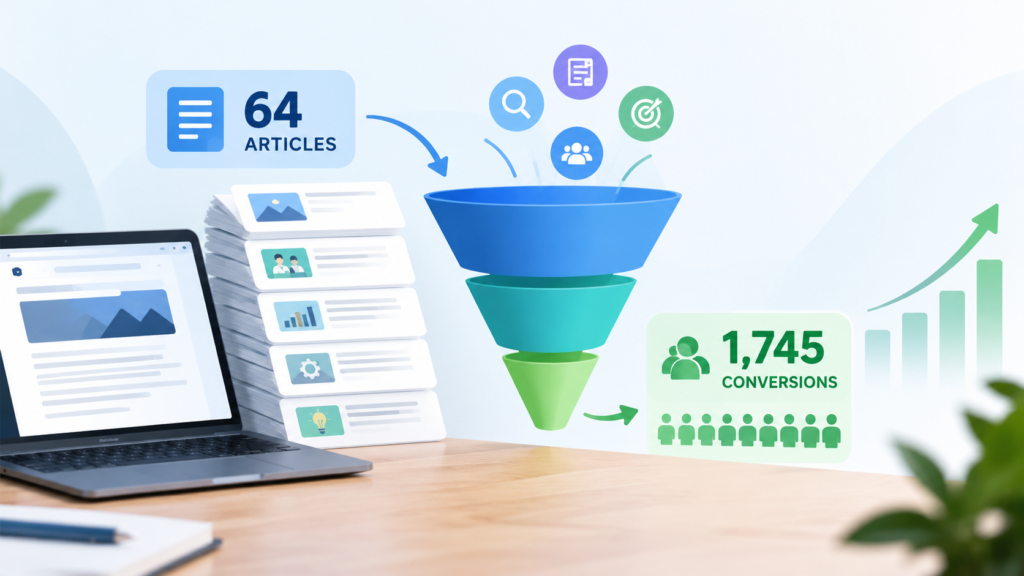
By examining an extensive dataset encompassing 64 published articles, over 230,000 organic site visits, and 1,745 free trial signups, this case study delivers actionable insights into keyword availability, relative conversion efficiency, and the undeniable long term brand advantages of top of funnel search topics.
The Market Context: SyncPulse and Asynchronous Workflows
To understand the dataset and strategic execution, it is helpful to establish the operational background of SyncPulse.
SyncPulse is a self service B2B SaaS platform designed to streamline daily operations for software development teams, product organizations, and engineering departments.
The Core Customer Pain
In traditional office environments and modern remote setups alike, engineering teams frequently rely on live, synchronous daily standup meetings. These gatherings typically occur in person or via video conference calls. While intended to keep team members aligned on daily goals, live standups introduce significant operational friction. They interrupt deep focus time, force engineers to stop coding, fragment the working day, and present major scheduling hurdles for distributed teams working across multiple time zones.
The Software Solution
SyncPulse solves this friction by enabling teams to conduct completely asynchronous daily standups and status updates directly within their primary internal team communication channels. Team members answer automated daily prompts at a time that suits their personal workflow, eliminating the need for synchronous video meetings, preserving uninterrupted work blocks, and keeping leadership fully informed without disrupting productivity.
Although SyncPulse represents a clear B2B SaaS use case, the strategic framework, conversion dynamics, and funnel transition principles covered in this study apply directly to B2C platforms, e commerce brands, and enterprise software providers alike.
Mapping Keyword Distribution: Bottom of Funnel versus Top of Funnel
When building out the content program for SyncPulse, the initial mandate was simple: capture every piece of existing bottom of funnel search intent available in the market before allocating resources toward broader educational content.
Over the course of roughly two years, 64 comprehensive articles were published on the SyncPulse blog. The breakdown between bottom of funnel and top of funnel topics reveals a common reality in software marketing:
- Bottom of Funnel Articles: 22 total articles published, accounting for 34.4 percent (roughly one third) of the total content library.
- Top of Funnel Articles: 42 total articles published, accounting for 65.6 percent (roughly two thirds) of the total content library.
Notice that top of funnel articles ultimately outnumbered bottom of funnel pieces by nearly two to one. This distribution was not the result of a flaw in initial planning; rather, it was a direct reflection of natural keyword availability.
Depending on the maturity of a software category and the size of the target market, some companies may possess fifty or more bottom of funnel keywords, while others may only have ten. In the case of SyncPulse, the complete inventory of true bottom of funnel terms was exhausted after publishing 22 targeted pieces. At that point, continuing to produce content required a deliberate strategic expansion up funnel.
Defining Bottom of Funnel Content
In a revenue first content framework, bottom of funnel terms are defined as search queries where explicit product buying intent is present in the searcher’s mind. The user is actively seeking software to evaluate, test, or purchase immediately. Educating the user about their problem is unnecessary because they already understand their pain point and are actively searching for a commercial solution.
Key examples of bottom of funnel topics produced for SyncPulse include:
- Use Case Plus Software Keywords: Articles targeting explicit product searches such as daily standup software. The individual entering this query has already decided to implement a software tool for daily standups and is evaluating available market options.
- Competitor Plus Alternative Keywords: Articles targeting competitor search terms such as StandupBot alternatives. The searcher is either dissatisfied with a competing product or actively comparing alternatives before making a purchase decision.
In both instances, the search query demonstrates that the user is standing at the cash register with an open wallet.
Defining Top of Funnel Content
In contrast, top of funnel keywords represent search queries where the user is experiencing a specific problem, seeking an immediate template, or researching general industry questions, but is not explicitly searching for a commercial software platform.
To maximize the commercial viability of top of funnel content, topics should still align closely with the core pain points of the target persona. This approach, known as Pain Point SEO, ensures that even broad educational articles maintain a logical connection to the product’s primary value proposition.
Key examples of top of funnel topics produced for SyncPulse include:
- Frustration with Existing Processes: Articles targeting queries like standup meetings waste of time. This search term reflects a high degree of frustration with traditional meeting formats. While the user is not explicitly typing the word software, the article can directly validate their pain point and introduce automated asynchronous standups as the logical solution.
- Non Software Solution Seekers: Articles targeting queries such as daily standup Excel template. The searcher is attempting to solve their operational challenge using a free spreadsheet tool. The content satisfies their immediate demand by offering a downloadable template while simultaneously illustrating the severe operational limitations of spreadsheet tracking compared to an automated platform like SyncPulse.
- Informational and Educational Queries: Articles targeting beginner queries like daily standup questions. The searcher is looking for basic tactical guidance on structuring team updates. The content provides thorough answers to their query while naturally integrating SyncPulse as an effortless way to automate those exact questions every morning.
The Hard Conversion Data: Comparing Performance Across 64 Articles
While theoretical concepts provide helpful direction, real world dataset metrics demonstrate the true commercial performance of each funnel stage.
Over the two year analysis period, the 64 articles published on the SyncPulse blog generated a total of 232,493 organic page visits and produced 1,745 qualified free trial signups.
A detailed breakdown of the performance metrics across both content tiers reveals stark differences in traffic volume and conversion efficiency:
Aggregate Performance Summary
- Total Published Articles: 64 articles
- Total Organic Traffic: 232,493 visitors
- Total Trial Conversions: 1,745 signups
Bottom of Funnel Content Performance
- Articles Published: 22 articles (34.4 percent of total)
- Total Organic Traffic Generated: 28,190 visitors (12.12 percent of total traffic)
- Total Free Trial Conversions: 1,348 signups (77.24 percent of total conversions)
- Average Conversion Rate: 4.78 percent
Top of Funnel Content Performance
- Articles Published: 42 articles (65.6 percent of total)
- Total Organic Traffic Generated: 204,303 visitors (87.88 percent of total traffic)
- Total Free Trial Conversions: 397 signups (22.76 percent of total conversions)
- Average Conversion Rate: 0.19 percent
Analyzing these concrete figures yields three foundational findings that should reshape how SaaS executives approach content investments.
       CONVERSION RATE COMPARISON
       ==========================

  BOTF Content: [4.78%]  <-- 25x Higher Efficiency
  TOF Content:  [0.19%]
Key Finding 1: Bottom of Funnel Content Converted at a Rate 25 Times Higher Than Top of Funnel Content
Prior research has repeatedly demonstrated that bottom of funnel topics convert at higher rates than broad informational posts. However, this dataset from SyncPulse represents an exceptionally robust sample size, spanning 64 individual pieces, hundreds of thousands of sessions, and nearly 1,750 verified conversions.
The data reveals that the difference in conversion efficiency was not a minor variation of 50 percent or even a 2x lift.
Bottom of funnel articles achieved a 4.78 percent conversion rate, whereas top of funnel articles achieved a 0.19 percent conversion rate.
This represents a 25x difference in conversion efficiency, or a 2400 percent higher conversion rate for bottom of funnel content.
To put this in practical business terms, out of every 100 visitors who landed on a bottom of funnel article (such as a software comparison or competitor alternative guide), nearly 5 visitors signed up for a free trial. Conversely, for top of funnel articles, it required more than 500 visitors to produce a single trial signup.
When prospective buyers are actively seeking a solution, friction disappears. They do not require months of lead nurturing, elaborate email cadences, or repetitive retargeting campaigns. They simply need a clear demonstration of product capability, transparent pricing details, and a seamless path to sign up.
Key Finding 2: Bottom of Funnel Posts Outperformed in Total Conversions Despite Receiving 7 Times Less Traffic
A frequent objection raised by traditional search engine marketers centers on volume. Marketers often argue that while bottom of funnel keywords convert at higher percentages, their search volumes are far too low to build a meaningful growth strategy. They claim that the massive traffic potential of top of funnel educational terms will easily compensate for lower conversion percentages.
The empirical metrics from SyncPulse definitively disprove this assumption.
       TRAFFIC VS CONVERSIONS BREAKDOWN
       ================================

  Organic Traffic Volume:
  - BOTF:  28,190 visitors  (12% of total traffic)
  - TOF:  204,303 visitors  (88% of total traffic)  <-- 7x More Traffic

  Total Free Trial Signups:
  - BOTF: 1,348 signups    (77% of total leads)    <-- 3x More Signups
  - TOF:    397 signups    (23% of total leads)
Top of funnel articles attracted 204,303 visitors, compared to just 28,190 visitors for bottom of funnel articles. That represents more than 7 times more organic traffic flowing to top of funnel content.
However, because bottom of funnel articles converted at a 25x higher rate, they generated 1,348 total free trial signups, compared to 397 signups from top of funnel pieces.
Bottom of funnel content delivered more than 3 times the total volume of customers while operating with 7 times less organic traffic.
This metric illustrates why measuring content performance strictly by traffic volume creates misaligned growth strategies. A blog that attracts 10,000 monthly visitors through high intent purchase terms will consistently outgenerate a blog pulling in 100,000 monthly visitors through generic educational guides. High conversion velocity easily overcomes low search volume.
Key Finding 3: Top of Funnel Content Still Generated Significant Pipeline Value
Given the drastic difference in conversion rates, a common misconception is that top of funnel content is entirely useless and should be completely avoided.
That conclusion misinterprets the primary lesson of this data.
While bottom of funnel content drove the majority of signups (1,348), the 397 conversions generated by top of funnel content represented an invaluable expansion of the customer base. For any early stage or scaling B2B SaaS platform, capturing nearly 400 additional qualified product trials is a major revenue win.
The core argument is not about eliminating top of funnel content; it is entirely about strategic prioritization.
If a company’s immediate objective is to maximize customer acquisition speed and revenue return per marketing dollar spent, resources must be allocated to bottom of funnel opportunities first. Passing up 1,348 bottom of funnel conversions to chase broad top of funnel traffic represents a severe strategic error. However, once those high intent terms have been fully captured, moving up funnel becomes the logical and necessary strategy to unlock secondary growth.
Failing to harvest top of funnel opportunities after exhausting bottom of funnel terms leaves 397 prospective buyers on the table. The key is knowing precisely when to transition.
Understanding the Measurement Gap: The Hidden Impact of Top of Funnel Traffic
Standard web analytics applications, including standard platform tracking tools, inherently struggle to attribute top of funnel conversions accurately. While the data shows 397 direct signups from top of funnel posts, the true conversion contribution of educational content is almost certainly higher due to systemic attribution limits.
Three major attribution barriers obscure the full revenue impact of top of funnel content marketing:
1. Cross Device Journey Friction
A decision maker often discovers an educational article while searching on a mobile device during a commute or break. They read the post, note the software brand, but refrain from registering for a technical B2B trial on a mobile screen. Hours or days later, they open a web browser on their desktop computer, type the company URL directly into the address bar, and sign up for a trial. Standard first touch and last touch analytics models attribute that conversion entirely to direct homepage traffic, stripping the blog post of its rightful conversion credit.
2. Time Gaps Exceeding Standard Tracking Windows
Most analytics platforms enforce a standard 90 day attribution window. When an engineering manager reads a blog post about optimizing team standups, they might not require a new software tool immediately. However, four or five months later, when their development team expands and meeting overhead becomes unbearable, they return directly to the brand they researched months prior. Because the elapsed time exceeds the 90 day window, tracking platforms register the conversion as an untraceable origin, disguising the blog post’s role in initiating the customer relationship.
3. Word of Mouth and Internal Team Advocacy
Top of funnel content frequently functions as an internal referral engine. A senior developer reads an article explaining how to streamline sprint updates and shares the link in an internal chat room with their VP of Engineering. The VP opens the link, reviews the software features, and proceeds to register the company for an account directly. The original searcher never converted, and the ultimate decision maker entered through a direct link. Digital tracking scripts cannot record offline word of mouth or internal corporate messaging transfers.
The Misuse of Attribution Limits
In content marketing discussions, executives frequently encounter a common paradox regarding unmeasurable traffic.
Many marketing agencies use attribution tracking limits as a blanket excuse for why their high volume awareness campaigns produce zero visible leads. They argue that traffic is building brand equity behind the scenes in ways that digital software cannot measure.
The strategy demonstrated in this study takes the opposite position:
- Demonstrate Immediate Value First: Capture verifiable, directly trackable conversions through bottom of funnel terms to prove clear marketing return on investment.
- Move Up Funnel Second: Expand into top of funnel topics with full knowledge that while documented direct conversion rates will drop (0.19 percent in this study), additional unmeasurable pipeline value is actively accumulating through brand awareness, social sharing, and delayed signups.
Unmeasurable brand benefits should serve as an added bonus on top of proven performance, never a shield to disguise non performing content strategies.
Strategic Roadmap: Executing a Revenue First Content Strategy
For B2B SaaS founders, marketing managers, and content strategists looking to apply these findings, execution requires a structured three phase methodology.
   PHASE 1: BOTF Capture  -->  PHASE 2: TOF Expansion  -->  PHASE 3: Optimization
   (High Intent / 4.78% CR)   (Pain Point / 0.19% CR)     (Lead Attribution)
Phase 1: Exhaust Bottom of Funnel Buying Intent
Begin by conducting an exhaustive audit of search terms where the user displays immediate purchase intent.
Focus initial publishing resources exclusively on these high intent categories:
- Category Software Terms: Keywords that combine product category names with software, tool, platform, or app (for example, daily standup software, asynchronous meeting platform, developer standup app).
- Competitor Alternative Terms: Keywords used by prospects seeking to switch away from existing providers (for example, CompetitorX alternatives, best replace CompetitorY).
- Product Comparison Terms: Keywords used by shoppers evaluating two leading tools side by side (for example, CompetitorX versus CompetitorY, SyncPulse versus CompetitorX).
- Use Case and Solution Terms: Queries targeting precise operational deployments (for example, remote standups for distributed engineering teams).
When writing bottom of funnel content, avoid introductory fluff. State the value proposition immediately, embed clear callouts to product features, display real product interface visuals, and present direct pricing or free trial links throughout the body of the article.
Phase 2: Systematically Transition Up Funnel via Pain Point Topics
Once all true bottom of funnel terms are published and ranking, expand the keyword strategy into top of funnel topics. To preserve conversion potential, select top of funnel topics using the principles of Pain Point SEO rather than targeting generic industry terms.
Structure top of funnel content around these buyer intent tiers:
- Alternative Solution Queries: Target searchers looking for non software fixes, such as templates, spreadsheets, or manual processes (for example, daily standup Excel template). Provide the requested resource, detail its operational drawbacks, and demonstrate why automated software provides a superior long term outcome.
- Frustration and Problem Queries: Target queries expressing dissatisfaction with current industry methodologies (for example, why daily standups waste engineering time). Validate the user’s frustration, detail why traditional methods fail, and present your platform as the ideal solution.
- Tactical Educational Queries: Target operational questions asked by your target persona (for example, best questions for daily standups). Answer the query thoroughly while demonstrating how your product automates or simplifies those operational steps.
Phase 3: Implement Direct Lead Tracking Across the Entire Funnel
To maintain strict financial accountability, shift primary marketing key performance indicators away from traffic volume and keyword rankings, focusing instead on lead generation and acquisition cost.
Configure analytics tracking architectures to capture:
- First Touch and Last Touch Signup Attribution: Track exact landing page URLs associated with free trial registrations, account creations, and demo requests.
- Page Level Conversion Rates: Calculate specific conversion percentages for every published piece of content to distinguish top performing assets from weak pages.
- Content Revenue Contribution: Connect CRM signup data to closed recurring subscription revenue to determine the exact cash return produced by individual articles.
Conclusion: Balancing Prioritization and Long Term Scale
Content marketing for B2B SaaS products does not require choosing strictly between bottom of funnel lead generation and top of funnel brand building. Rather, it requires establishing a disciplined sequence of execution.
The quantitative evidence from SyncPulse’s 64 article dataset confirms that bottom of funnel keywords are the undisputed engine of rapid lead generation. Converting visitors at a 4.78 percent rate, bottom of funnel posts delivered 25 times the conversion efficiency of top of funnel topics and produced over 75 percent of all trial signups while consuming only a fraction of total page traffic.
However, because high purchase intent keywords exist in finite supply, scaling a content engine inevitably requires moving up funnel. While top of funnel topics convert at a lower rate (0.19 percent in this study), they expand brand visibility, capture secondary buyers, and generate hundreds of additional conversions that compound total revenue over time.
By capturing every high intent buying keyword first before systematically moving up funnel into pain point educational topics, B2B software companies can build a predictable, revenue generating content engine that maximizes immediate trial signups while laying the groundwork for sustainable long term brand authority.