
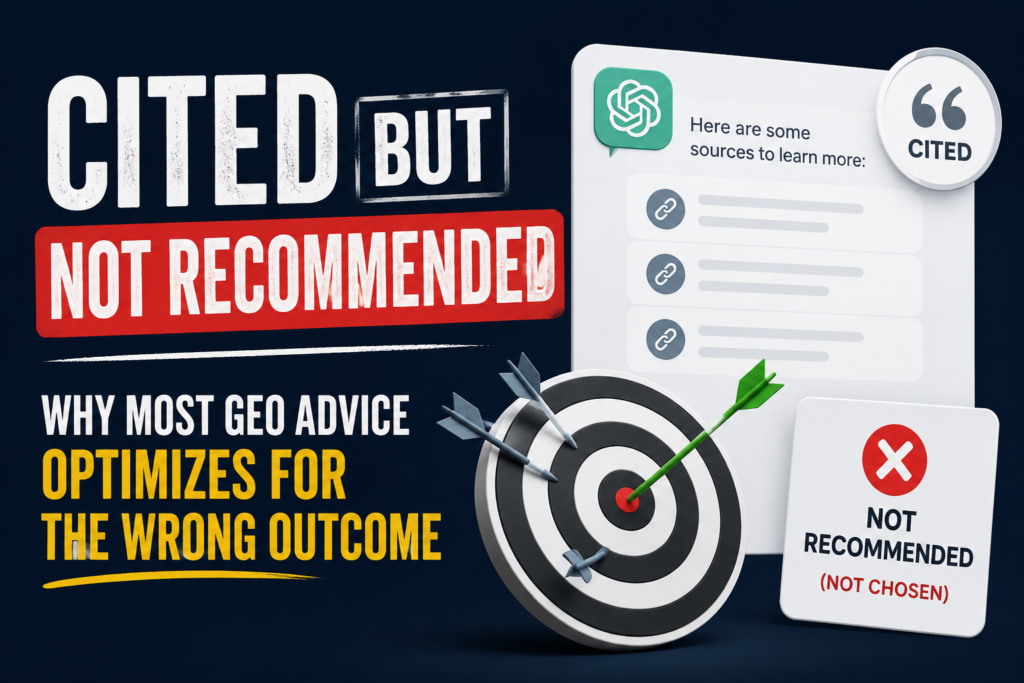
Almost every guide to showing up in ChatGPT, Perplexity, and Google AI Overviews is built around two goals. Get cited. Make your pages easier for a language model to parse.
Neither goal is wrong. Both are incomplete, and the distance between them and an actual sales conversation is wider than most marketing teams realize.
The question worth organizing your work around is narrower and harder: how do you get a language model to recommend your brand to someone who is ready to buy?
That reads like a rewording of the same objective. It is not. Hold the popular GEO tactics up against that question, and a surprising number of them stop justifying the hours they consume.
Start with the assumption sitting underneath most AI visibility reporting, which is that a citation counts as a win. A brand can be cited twice inside a single ChatGPT answer and still be absent from the list of products that the answer recommends. Grow and Convert documented a clean version of this with Melp App, a Microsoft Teams alternative that earned two citations on a prompt about good team chat software for remote teams, but then never appeared in the recommended list printed above those citations. That prompt sits at the dead center of the company’s business. Most agencies would report those two citations as progress and move on.
Now think about how you read an AI answer yourself. When ChatGPT hands you five product names and a paragraph on each, how often do you open the citation tray and start reading source articles? Almost never. You either act on the recommendation or you ask a follow-up question. Buyers behave the same way. The citation list is a footnote. The recommendation is the product.
We have reviewed AI visibility dashboards where the citation count climbed every month, while the sales team heard nothing new on discovery calls. That gap is not a measurement problem. It is a strategy problem.
What follows is our read on the 8 GEO tactics that circulate most widely, what each one actually does, the strategy we run for clients instead, and how we measure whether any of it is working.
One note on labels before we start. This work is called GEO, AEO, AIO, LLMO, and AI SEO, depending on who is writing. We use GEO. The label matters far less than what you decide to spend your Tuesday on.
The lens: exposure versus comprehension
Every GEO tactic does one of two jobs, and confusing them is the single most expensive mistake we see.
The first job is exposure. This is getting your brand in front of the model in the first place, whether through the web searches it runs while answering a prompt or through the volume of writing about your brand that existed when the model was trained. No exposure means no recommendation, regardless of how clean your markup is.
The second job is comprehension. This is helping a model understand your content once it has already found it. Structured data, question-formatted headings, FAQ blocks, key takeaway boxes, and llms.txt all live here.
Comprehension tactics are cheap, concrete, and satisfying to complete, which is exactly why they dominate GEO checklists. They are also the ones that fix a problem language models mostly do not have. Modern models read dense, badly formatted, messy text better than your average human skimmer does. Solving comprehension for a reader who already comprehends fine is busywork with a progress bar attached.
Sort the 8 tactics below by the job they do, and the priority order stops being a matter of opinion.
1. Reverse engineering fan-out queries
When ChatGPT searches the web to answer a prompt, it does not run one search. It breaks the prompt into smaller subqueries, often called fan-out queries, and pulls from several sources at once. The tactic built on top of this is to identify those subqueries, rank for them like keywords, and collect citations.
The first problem is practical. You cannot see the fan-out queries, and you cannot reliably see the prompts that generated them either. No LLM provider publishes this data. The tools promising you the real prompts driving AI traffic are working from user panels and modeling, which produces a directional signal at best and false precision at worst.
The second problem is structural, and it does not go away with better tooling. We call it the invisible prompt.
The literal prompt is what the buyer typed. The effective prompt is what the model actually answers, which is the literal prompt plus everything it knows about that person: their industry, company size, tooling, budget, what they complained about in a chat three weeks ago, and what is sitting in memory from onboarding. The effective prompt is frequently the equivalent of a detailed brief on one specific buyer’s situation.
Think of it as digital word of mouth. When a friend recommends a surfboard, they are not answering the question you asked. They are answering the question you asked, filtered through the fact that you are a beginner, you are heavy, you surf beach breaks, and you already complained about price once. A model does the same thing at scale.
So two people typing identical words get materially different answers, and neither of them matches the answer your tracking tool recorded from a clean account with no history. Treating prompts as keywords with search volume imports a mental model from SEO into a channel that does not have the property that made the model work. Prompts are not repeatable across users. Assuming they are the root error behind half the GEO tooling on the market.
Verdict: skip it as a targeting strategy. Later in this piece, we cover what replaces it, which is coverage broad enough that the model can match you to prompts you will never see.
2. Publishing comprehensive, quotable content
The standard advice says to publish thorough content, load it with statistics, format it for extraction, and you give models both the authority signals and the raw material they need to surface your brand.
We agree with the premise. Depth wins. Our objection is that the advice almost never says what to write about, and the default assumption fills in the blank with top-of-funnel explainers.
Here is the part that gets left out: write about your product. Not around it. About it. Categories you compete in, competitors buyers weigh you against, use cases you serve, personas you serve them for, and the specific pain points you solve for each one.
Depth only pays off when it is aimed at product intent topics, because that is the only content that teaches a model when to name you. A comprehensive 4,000-word guide to remote team culture might earn citations for years and never once move you into a recommendation list.
The reason depth matters at the bottom of the funnel is that buyers hand models an enormous amount of context. A Google searcher types “best project management software” and stops. The same person in ChatGPT explains that they run a 12-person distributed engineering team; they are currently coordinating in a spreadsheet; they need GitHub and Slack integrations; they have roughly $500 a month to spend; and they abandoned Asana because it felt too rigid.
The model takes that whole picture and matches it against what it knows about the available options. If your site never explains that you integrate natively with GitHub, that your pricing lands under $500 at that seat count, and that teams switching from Asana usually cite flexibility as the reason, you are not in the running. Not because you were outranked. Because nothing in the corpus connected your product to that situation.
Original data and named customer outcomes make good content better and give models concrete material to work with. They are a layer on top of a product content strategy, not a replacement for one. Statistics inside a top-of-funnel explainer produce citations. Statistics inside a detailed page explaining why your product fits a specific buyer produce recommendations.
Does writing about your own product get you penalized?
There is a persistent fear that models suppress promotional content and reward neutral editorial writing, which pushes teams toward publishing listicles where they bury themselves in position 7 for the sake of appearing objective.
We have not seen evidence for it. The listicles that get pulled into AI answers routinely include vendors ranking themselves first. What gets ignored is thin content, not commercial content. A page that names your product first and then spends 600 words explaining exactly which team size, budget, and workflow it suits will beat a page that lists 15 tools with two neutral sentences each, every time.
Rank yourself first. Then earn it by going deeper into your own product than anyone else on the page bothered to.
[TO BE FILLED: our own client example of a self-ranked listicle appearing in AI recommendations]
3. Adding an llms.txt file
llms.txt was proposed in 2024 as a rough analogue to robots.txt, a curated map pointing AI systems at the pages you consider most important. Several SEO tools shipped generators for it, and a number of widely read publications recommended it.
No major AI platform has confirmed using it in any meaningful way. Independent testing has not found a measurable effect on AI visibility. An analysis covering 300,000 domains found no correlation between having the file and how often a site was cited. Squirrly, an SEO tool that shipped llms.txt support because customers asked for it, said publicly that there is no proof it helps a brand get promoted by AI search engines.
The appeal is obvious. It is a discrete, completable task with a clear finish line, which is a rare thing in a channel where most of the real work takes months. It also does nothing for exposure. A file on your domain cannot introduce you to a model that has never had reason to fetch your domain.
Verdict: 20 minutes of work, harmless, not a strategy. Ship it if it costs you nothing and stop reporting it as an AI visibility initiative.
4. Implementing schema markup and structured data
FAQ schema, HowTo schema, and Organization markup are recommended on the logic that structured data helps models parse your pages and signals authority.
Schema is a reasonable site hygiene, and it still does useful work in traditional search. As a lever for AI recommendations, it is a comprehension tactic wearing an exposure tactic’s costume. It makes a page you already own slightly easier to interpret for a system that was going to interpret it correctly anyway.
Verdict: keep it in the backlog, never at the top of it. If schema implementation is competing for the same sprint as three product comparison pages, publish the pages.
5. Rewriting headings as questions and bolting on FAQ sections
The reasoning here is that models process conversational, question-shaped content more naturally and that FAQ blocks provide clean, extractable answers.
Language models handle dense, unformatted, technical prose more capably than most human readers do. Question formatted headings are a human readability choice, and sometimes a good one. They are not an AI visibility lever.
The evidence runs against the tactic. Grow and Convert reports that content they produced for a lending client, long and dense material with no FAQ blocks and no question-formatted headings, appears in the top 3 AI recommendations across more than 50 bottom-of-funnel prompts on ChatGPT, Perplexity, and Google AI Overviews. Content earns that position through what it says about the product, not through the shape of its H2 tags.
Verdict: format for humans, then spend the remaining time on coverage. An afternoon spent rewriting 40 existing headings buys you less than an afternoon spent drafting one page about a use case you have never documented.
6. Chasing Reddit and third-party mentions
The premise is that models lean heavily on user-generated content, so brand mentions on Reddit and Quora translate into AI visibility. Sitting behind it is a broader assumption that a universal list of trusted domains exists and gets consulted on nearly every query.
The data does not support the universal list. In a study covering more than 100 prompts across 5 industries, Grow and Convert found that 86% of citations came from industry-specific domains, frequently the vendors’ own blogs, while general-purpose sites including Reddit and Wikipedia accounted for 16%.
That matches how these systems behave when you watch them work. Ask ChatGPT for the best dispatch software for trucking companies, and it does not go browsing a canonical list of trusted sites. It goes looking for sources that are actually relevant to trucking dispatch software, which are overwhelmingly trade publications, review sites in that category, and vendor blogs.
There is also concentration risk. Any strategy anchored to one platform inherits that platform’s weighting decisions. ChatGPT quietly reduced Reddit’s prominence in September 2025, and brands that built their AI visibility on Reddit threads absorbed the change without warning.
The wider version of this advice is a “be everywhere” digital PR push, and we will be fair to it: it works. The more often your brand name appears in association with your category, the more likely a model is to treat you as a credible option in it. The problem is cost. Sustained multi-channel PR is one of the most expensive things a marketing team can buy, and most companies asking about GEO cannot fund it.
Verdict: right instinct, wrong targeting. The version we run is citation outreach, covered below, which goes after the specific pages models already cite for your buying intent prompts instead of the domains that appear on a generic top-cited sites chart.
7. Building EEAT signals and author credentials
Strengthening EEAT (Experience, Expertise, Authoritativeness, Trustworthiness) usually means adding named authors with credentials, expert review notes, and firsthand material instead of recycled research.
This is directionally right for the wrong stated reason. Models are not reading your author bio and deciding to trust you more. EEAT signals improve how you rank in Google, and because models ground their answers in web search results, better rankings put you in front of them more often. The credibility runs through the rankings, not through the byline.
What moves the needle is the firsthand product knowledge that EEAT advice gestures at without specifying. Before we write anything for a client, we interview their product and sales teams to extract the features, differentiators, positioning, objections, and customer outcomes that make the product distinct. That material is what a model uses to match a brand to a buyer. When ChatGPT recommends a company using language that closely tracks their own site copy, it is because somebody took the trouble to write down exactly when and why that product is the right call.
Verdict: Do the interviews, skip the credential theater.
8. Optimizing specifically for Bing
This one applies to ChatGPT, which has a well-documented relationship with Bing for web search. The argument follows logically: if ChatGPT searches Bing, optimize for Bing.
The overlap makes it mostly redundant. Grow and Convert analyzed 100 buying intent prompts and compared ChatGPT’s cited sources against both Google and Bing results. Only 8% of citations appeared in Bing without also appearing in Google. Rank in Google, and you have already captured roughly the entire search-driven surface area ChatGPT can reach.
Submitting your sitemap through Bing Webmaster Tools takes 15 minutes and costs nothing. Do it, then stop thinking about it.
What we run instead: Exposure First GEO
Our GEO work is organized as a three-tier pyramid. The ordering is the whole point. Every tier is defensible in isolation, and teams get into trouble by starting at the top.
Tier 1: owned bottom-of-funnel content that ranks on Google
Owned content is the foundation for 4 reasons.
- You control the narrative. Your own site is the only place you can go as deep as you want on features, ideal customer profiles, competitor differentiators, and the exact pain points you resolve. A Reddit thread will not give you 1,200 words on why teams migrating from a specific competitor stay.
- It doubles as SEO. Traditional search still sends more traffic than AI referrals for most businesses, and Google rankings feed AI Overviews directly. One content investment, two channels.
- It carries less update risk. If your AI visibility depends on 2 third party pages, you are one weighting change away from losing it. Your own domain is part of the broad corpus these systems draw from and is far harder to update away.
- Your team can actually execute it. Most marketing teams already know how to research and publish a page. Very few know how to reliably earn placements in trade publications.
The instinct at this point is to build a keyword list, and that is where traditional SEO thinking leaks back in. A keyword list cannot anticipate the situations buyers describe in a chat window.
We build a topic map instead: a coordinated set of product-specific content covering every angle that matters commercially. Your category and its variants. Every competitor you get compared against. Every use case. Every persona. Every objection your sales team fields twice a week. The map is judged by coverage, not by search volume, because the prompts you are trying to win are invisible, and the only defense against invisible questions is a surface broad enough that one of your pages answers each of them.
Coverage also builds authority at the domain level, which matters more than page-level ranking in this channel. In Grow and Convert’s fan-out query study, the overlap between ChatGPT’s cited sources and Google results rose from 27% to roughly 50% once matches were counted by domain rather than by exact URL. Models pull from sites they associate with a topic, not only from the individual pages that happen to rank.
[TO BE FILLED: our own topic map example, ideally a client’s coverage grid and the visibility change over 90 days]
Tier 2: off-site mentions on the sources models actually cite
Once the foundation exists, third-party validation amplifies it. The method matters more than the channel.
Rather than pursuing sites that appear frequently in aggregate citation charts, we identify the specific articles models cite when answering the buying intent prompts relevant to that client’s category, then run outreach to get the brand included in those articles. Same activity as digital PR, aimed with a rifle instead of a hose, and priced accordingly.
Tier 3: on-site tactics
Schema, llms.txt, FAQ blocks, question-formatted headings, Bing verification. Everything covered above helps a model understand a page it has already found.
Some of these are worth doing for hygiene. None of them belong in a GEO strategy deck until Tier 1 and Tier 2 are genuinely solid, and “solid” means your topic map has coverage, not that you published 6 blog posts last quarter.
How to measure whether it is working
Attribution in AI search is messy, and anyone showing you a precise dollar figure for AI-driven revenue is selling confidence rather than data. Here is what we use, in ascending order of usefulness.
Manual querying. Write down the prompts a real buyer would type when evaluating solutions like yours, then run them through ChatGPT, Claude, Perplexity, Gemini, and Google AI Mode. Record whether you appear, where in the answer, and how you are described. It costs nothing, and it gives you a ground-level read on which topics need investment. The limitation is consistency: responses vary between runs and accounts, so 10 manual checks are anecdotal, not a measurement.
Topic-level visibility tracking. This is where most AI visibility tools fail, because they blend everything into one brand visibility percentage. That number is close to useless. Your visibility on “content marketing agencies for SaaS” and your visibility on “content marketing for fintech companies” are separate signals demanding separate work, and averaging them hides the only information you could have acted on. Worse, a blended score creates a bad incentive: adding a new topic where you currently sit at zero drags the average down, so teams quietly avoid tracking the topics they most need to win.
Track visibility topic by topic and platform by platform. Report which topics are strong, which are weak, and which have not been attempted. [TO BE FILLED: name and describe the tracking setup we use for clients]
GA4 referral traffic. A regex filter capturing referrals from AI platforms gives you a trend line and undercounts badly. Someone who got recommended your product in a chat on Monday might arrive through a branded Google search on Thursday, and that visit is attributed to organic. Watch the direction, not the magnitude. Rising referral volume alongside rising content output is a positive signal even though the absolute number is wrong.
Asking prospects directly. The most underrated instrument available is one field in your demo form. “How did you hear about us?” surfaces AI search earlier and more reliably than any analytics tool because leads volunteer it. They describe a conversation that ran for 20 minutes and ended with a model telling them to try 3 products, yours among them. None of that appears in GA4. All of it appears when you ask.
Read the trajectory across all 4 signals rather than defending any single metric. Perfect attribution is not available in this channel yet. A clear directional read on whether the strategy is working is, and it is enough to make decisions with.
Where this leaves you
The uncomfortable part of GEO is that the highest leverage work looks almost identical to good bottom-of-funnel content marketing. There is no file to upload, no markup to inject, no directory to submit to. There is the slow accumulation of detailed, honest, specific writing about what your product does and who it is right for, published somewhere you control, ranking in the search engine models run.
That is a worse pitch than a 12-point technical checklist. It is also the thing that puts your name in the answer rather than in the footnotes.
If you want a topic map built for your category and a visibility baseline that reports by topic instead of by vanity percentage, Prime Scope Marketing works with SaaS and B2B teams on exactly this. Tell us what you sell and who buys it, and we will show you the prompts you are currently missing.