
AI search is changing how B2B buyers discover software. Instead of searching Google for a list of products and comparing every option themselves, buyers can ask ChatGPT, Claude, Perplexity, Gemini, and other AI tools to research solutions, compare vendors, and recommend the best fit for their needs.
For B2B SaaS companies, this creates a new challenge. Having a great product and ranking for relevant Google searches does not automatically mean AI engines will recommend your brand when potential customers ask for solutions.
At Prime Scope Marketing, we approached this challenge by focusing on a simple question: How can we make an AI voice agent platform more visible in the specific conversations where its ideal customers are looking for solutions?
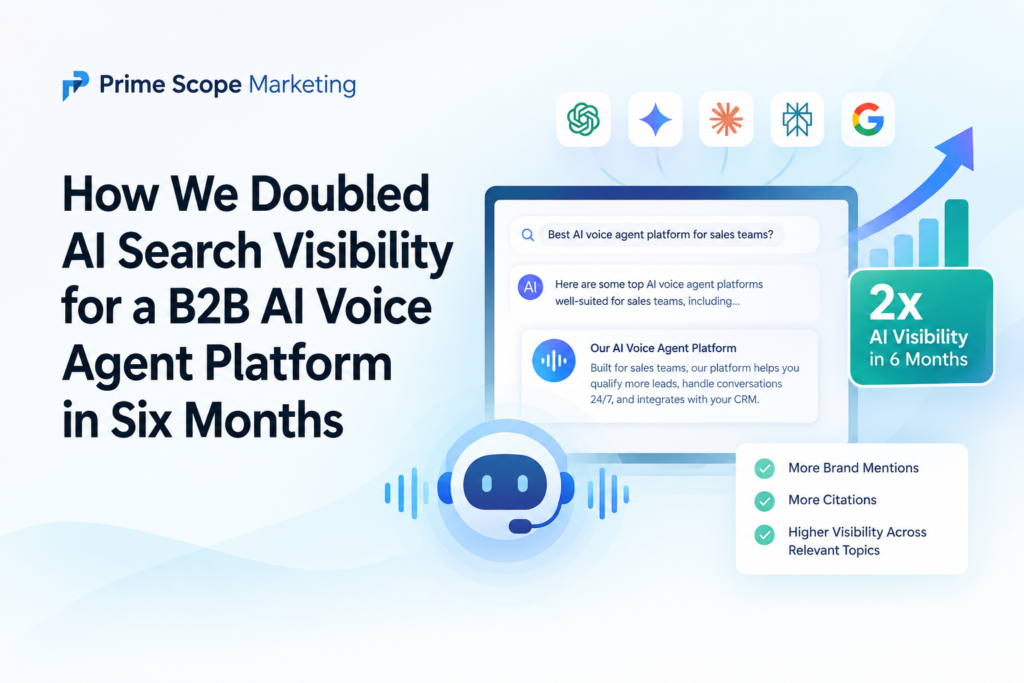
Over six months, we doubled the client’s AI search visibility by building a content strategy around its product capabilities, target industries, customer pain points, and specific use cases.
Rather than chasing generic AI visibility scores or publishing content simply because a topic was trending, we focused on giving AI engines detailed, relevant information about the problems the platform solves, the businesses it serves, and the situations in which it is a suitable choice.
This case study explains the strategy, the content decisions behind it, how we measured progress, and what other B2B SaaS companies can learn from the results.
The Results: Doubling AI Visibility in Six Months
Our objective was to increase the client’s presence in AI generated answers across the topics that mattered most to its business.
We did not approach AI visibility as a single ranking to improve. Instead, we looked at the broader set of conversations in which potential customers might discover, evaluate, or compare an AI voice agent platform.
These conversations included product category searches, industry specific requirements, competitor comparisons, and practical questions about implementing voice AI.
Over six months, the client’s AI visibility doubled.
More importantly, our strategy focused on building visibility across relevant topic areas rather than relying on a handful of successful prompts. This distinction matters because AI engines can produce different answers to the same question, and a brand that appears once may not appear consistently over time.
We wanted the client to become a relevant recommendation across the questions its potential customers were already asking.
The strategy also helped us identify the relationship between content, brand mentions, and citations. These measurements reveal different aspects of AI search performance and help explain whether a brand is becoming more visible and whether its website content is being used as a source.
It is important to distinguish visibility from traffic and conversions. Doubling AI visibility does not automatically mean doubling website visits or revenue. Those outcomes require separate measurement.
Our focus in this case study is the six month improvement in AI visibility and the strategy behind it.
Why AI Search Requires a More Specific Content Strategy
Buyers Are Moving Beyond Short Search Queries
Traditional search behavior often begins with a short keyword phrase.
A business looking for voice automation might search for terms such as AI voice agent software, AI calling software, or conversational AI platforms.
These searches remain valuable. They help companies discover relevant products and provide a foundation for understanding what buyers want.
However, AI search introduces a more conversational way to research software.
A buyer can explain their industry, existing workflow, budget constraints, technical requirements, and business objectives in a single conversation. They can ask follow up questions, refine their requirements, and request recommendations based on the context they have already provided.
For example, a sales leader might ask an AI engine to recommend a voice agent platform that can qualify inbound leads, integrate with an existing CRM, handle conversations outside business hours, and transfer qualified prospects to human representatives.
A healthcare operations manager might have a different set of requirements. They may be looking for voice automation that can manage appointment inquiries, answer routine questions, and route calls to the appropriate department.
Both buyers are interested in voice AI, but they have different problems, workflows, and expectations.
A generic article about the benefits of AI voice agents does little to explain how a particular platform fits either situation.
The more specific the buyer’s requirements become, the more important detailed product information becomes.
AI Engines Can Use Context Beyond the Immediate Question
AI search conversations can contain information that is not repeated in every prompt.
A buyer might explain their company size, industry, current software, and operational challenges earlier in a conversation. Later, they may simply ask which voice agent platform they should consider.
Depending on the AI product and its available context, the system may use information from earlier messages or other available context when formulating its answer.
We refer to the unspoken or previously established requirements behind a short question as invisible prompts.
For example, the visible question might be:
“What is the best AI voice agent platform for sales?”
But the surrounding context could reveal that the buyer runs a B2B SaaS company, receives a high volume of inbound leads, uses a particular CRM, and wants to qualify prospects before sending them to sales representatives.
The best recommendation for that buyer may differ from the best recommendation for a company that needs automated customer support or appointment scheduling.
This creates an opportunity for SaaS companies to publish content that clearly explains their suitability for different audiences and requirements.
A platform with strong content covering its use cases, integrations, limitations, implementation requirements, and customer outcomes gives AI systems more information to work with when evaluating its relevance.
The goal is not to predict every possible prompt. It is to make the relationship between the product and its ideal customers clear enough that the brand can be considered across relevant conversations.
AI Engines Do More Than Present a List of Websites
Traditional search engines generally provide a list of pages that users can visit and evaluate.
AI search tools can take on more of that research process. They may summarize information from several sources, compare products, explain differences, and recommend solutions for a particular situation.
This changes how content can influence the buying journey.
A potential customer might never visit a vendor’s website during the initial discovery process. Instead, they may learn about a product through an AI generated recommendation and investigate the brand later.
In this situation, the brand’s visibility in the answer matters even if the AI engine does not generate a direct website visit.
The quality of the information available about a product matters, too. If a brand’s website describes its capabilities in vague terms, AI engines have less specific information to use when explaining why the product may be relevant.
For this reason, we focused on making the client’s product positioning more specific and connecting its capabilities to real business requirements.
The more clearly a company explains who it serves, which problems it solves, and how its product works, the easier it becomes for buyers to evaluate its relevance.
Specific Content Helps Buyers Recognize Their Own Problems
Generic software content tends to repeat the same claims across competing websites.
An AI voice agent platform might claim that it improves efficiency, reduces operational costs, automates conversations, and provides better customer experiences.
These benefits may be accurate, but they do not explain much about the product’s suitability for a particular business.
A sales team wants to know whether the platform can qualify leads according to its criteria. A customer support team may want to understand how it handles routine inquiries and escalates complex cases. An operations team may care more about call routing, integrations, reporting, and the time required to deploy the system.
Specific content addresses these differences directly.
It explains the problem, the workflow involved, the relevant product capabilities, and the expected outcome. It also gives readers enough context to understand whether the solution fits their situation.
This is useful for human readers and gives AI engines more detailed information about the product’s relevance.
What We Did to Double AI Visibility
Our strategy followed four main steps: mapping the product’s use cases, identifying specific search opportunities, creating detailed content for those opportunities, and publishing case studies that demonstrated how the product worked in practice.
Each step supported the same objective: helping AI engines associate the client’s brand with the right problems and potential customers.
1. We Mapped Every Relevant Product Angle
Before producing content, we needed a complete understanding of the conversations in which the client’s platform could be recommended.
Starting with broad keywords would have limited our research. AI voice agents can serve different industries, perform different tasks, and support different workflows. Each of these dimensions creates a separate opportunity for relevant content.
We mapped the product across five areas.
Target industries
We identified the industries and business categories for which the platform could be relevant. Different industries have different communication requirements, call volumes, customer expectations, and operational constraints.
Use cases
We examined the specific tasks the platform could support. These might include inbound call handling, lead qualification, outbound calling, appointment scheduling, customer support, and routing conversations to human employees, depending on the client’s actual capabilities.
Features and integrations
We identified the product capabilities that mattered to each audience. These could include CRM integrations, conversation handling, call transfers, analytics, workflow configuration, and support for different communication requirements.
The objective was to understand which capabilities mattered to which customers, rather than treating every feature as equally important in every article.
Jobs the product helps customers complete
We also considered the business outcomes customers wanted to achieve.
A sales team may want to qualify more leads before sales representatives engage with them. A service business may want to handle more incoming calls without adding staff for every increase in demand. An operations team may want to standardize routine conversations and reduce manual work.
These jobs describe the practical reasons a customer would evaluate the platform.
Pain points the product addresses
Finally, we documented the problems that encourage customers to search for a solution.
These may include missed calls, slow response times, repetitive conversations, limited after hours coverage, inconsistent lead qualification, and rising costs associated with handling high call volumes.
The exact problems depend on the product and the customers it serves.
We used our understanding of the platform alongside discussions with the client’s team to connect these areas. We wanted to understand who benefited most from the product, which problems brought those customers to the market, and how the platform addressed those problems.
This research created a map of potential content opportunities.
It also helped us avoid producing articles that targeted a keyword without explaining why the client’s product was relevant to the searcher.
2. We Identified Highly Specific Search Opportunities
Once we had mapped the product, we researched SEO keywords and topic opportunities around each product angle.
This step connected traditional search optimization with generative engine optimization, commonly called GEO.
AI engines may use search engines and information from indexed websites to research products and answer questions. Relevant pages that rank in traditional search can therefore help AI systems discover and evaluate a product, although rankings alone do not guarantee AI visibility.
We used this relationship to build a content strategy around specific business requirements.
Industry Specific Topics
The first category focused on the needs of particular industries.
For an AI voice agent platform, potential topics could include:
- Best AI voice agents for B2B SaaS companies
- AI voice agents for healthcare appointment management
- AI calling software for sales teams
- Voice automation for customer support operations
- AI voice agents for businesses handling high call volumes
These are examples of the types of opportunities we would evaluate, not a claim that every topic was published for this client.
The underlying principle is that an industry specific article should explain what businesses in that industry need, why their requirements differ, and which product capabilities are relevant to those needs.
A general article about AI calling software cannot provide the same depth across every industry.
Feature Specific Topics
The second category focused on particular capabilities.
Examples include:
- AI voice agents with CRM integrations
- Voice AI platforms with automated call transfers
- AI voice agents with real time reporting
- Voice automation software with customizable workflows
- AI calling platforms with multilingual conversation support
These topics allow a company to explain how individual capabilities work and when they matter.
They also help buyers compare solutions according to practical requirements rather than broad marketing claims.
A feature focused article should explain the capability, the problem it solves, the conditions under which it is useful, and any relevant implementation considerations.
Use Case and Pain Point Topics
The third category focused on what buyers wanted to accomplish.
Examples include:
- How to qualify inbound leads using AI voice agents
- How to handle customer calls outside business hours
- How to automate appointment scheduling with voice AI
- How to reduce missed calls in a sales team
- How to automate repetitive customer inquiries
These topics connect the product to a problem that exists before the buyer chooses a software category.
They can attract people who understand their operational challenge but have not yet decided which type of product to purchase.
By addressing the problem directly, the content can explain the available approaches and show where voice automation may be appropriate.
Competitor Comparison Topics
We also considered the conversations that take place when buyers compare vendors.
Potential topics include alternatives to a competing voice agent platform, comparisons of AI calling software, and evaluations of different solutions for a specific use case.
These pages should explain meaningful differences between products, including relevant features, integrations, pricing considerations, implementation requirements, and limitations.
A comparison that simply declares one product superior provides little help to buyers. A detailed comparison gives them a reasoned basis for evaluating the available options.
It also provides more specific information about where the client’s product fits within the category.
Why We Did Not Focus Only on Search Volume
Many highly specific queries have low reported search volume. Some may show no measurable volume in traditional keyword research tools.
That does not automatically make them poor opportunities.
Traditional SEO often prioritizes keywords that can attract substantial organic traffic. Our GEO strategy also considered whether a topic represented an important buying conversation.
A query about the best AI voice agent for a specific sales workflow may have less search volume than a broad query about artificial intelligence. However, it can reveal much more about the searcher’s needs and buying intent.
The important question is not simply how many people search for a phrase. It is whether the topic helps connect the product with the right potential customers.
We therefore prioritized opportunities according to product relevance, customer pain points, search intent, and their relationship to the client’s commercial goals.
This created a more useful foundation for content production than chasing high volume keywords without considering the business context.
3. We Created Detailed Content Around Each Audience
Identifying a keyword opportunity is only the beginning. The content itself must explain the problem and connect the product to the audience’s requirements.
We approached each article by first understanding the reader’s situation.
What does this audience need to accomplish? What problems prevent it from achieving that outcome? Which product capabilities address those problems? What information would the reader need before considering the platform?
These questions influenced the entire article, from the introduction to the feature explanations and product comparisons.
We Started With the Reader’s Actual Problem
Consider an article about AI voice agents for B2B sales teams.
A generic introduction might describe the growing popularity of voice AI and list the general benefits of automation.
A more useful introduction would address the operational problem directly. Sales teams may struggle to respond to every inbound inquiry quickly, qualify prospects consistently, or maintain coverage when representatives are unavailable.
The article could then explain which types of voice automation can help, what a team should evaluate before implementation, and how the client’s platform fits those requirements.
This approach gives the reader a reason to continue because the content reflects a recognizable business problem.
It also creates a consistent connection between the topic, the audience, and the product.
We Connected Features to Business Outcomes
Feature descriptions are useful, but they become more valuable when readers understand their practical implications.
For example, saying that a voice agent integrates with a CRM does not explain why that integration matters.
A more complete explanation would describe how the integration can support a workflow, such as recording relevant call information, updating lead records, or helping sales teams maintain context across interactions, where the platform supports those functions.
Similarly, an article discussing call transfers should explain when a conversation might need to move to a human representative and how that process fits into the customer’s workflow.
The same principle applies to analytics, call routing, workflow configuration, and other capabilities.
We focused on explaining the relationship between a feature and the problem it addresses. This made the content more useful to readers and more precise in its description of the product.
We Adjusted Positioning for Each Audience
The same product should not necessarily be described in the same way to every potential customer.
A sales leader may care most about lead qualification, response speed, and how voice automation fits into the sales process.
A customer support manager may prioritize handling routine inquiries, escalation procedures, and consistency across customer interactions.
An operations leader may be more concerned with workload, reporting, system integrations, and implementation requirements.
These differences should influence the way an article presents the product.
We used the audience research to determine which capabilities deserved the most attention, which examples would be relevant, and which outcomes needed explanation.
The result was a content strategy built around the needs of individual audiences rather than a collection of pages repeating the same product description.
We Explained the Alternatives Fairly
Buyers rarely evaluate a software product in isolation.
They may compare several voice AI platforms, consider traditional call center software, explore conversational AI tools, or decide whether their existing process can be improved without adopting a new platform.
Useful content acknowledges these alternatives.
We approached comparisons by examining what buyers need to consider, where different solutions may fit, and which requirements should influence the decision.
This helps readers understand the category instead of forcing every discussion toward a predetermined conclusion.
It also gives AI engines more detailed information about the product’s relative strengths and suitable use cases.
We Made the Entire Article Consistent
Personalization cannot be limited to a few sentences in the introduction.
If an article targets sales teams, its feature explanations, examples, product positioning, comparisons, and conclusions should all reflect the needs of sales teams.
A page loses its focus when it begins with a specific audience but then returns to generic descriptions of the product.
We used the initial audience and pain point research to guide the entire article. Every section needed to contribute to the same central objective: helping the reader understand whether the platform could solve the problem being discussed.
This consistency is important because the way a company describes its product across its website can influence how readers understand its positioning.
It also gives AI systems a clearer and more complete explanation of the situations in which the product may be relevant.
4. We Published Case Studies Around Real Customer Problems
Product pages and educational articles explain what a platform can do. Case studies show how customers use it in practice.
For the client’s content strategy, customer stories offered another way to connect the product with specific business requirements.
A potential buyer may understand the general benefits of voice automation but still have questions about implementation. They may want to know how another company identified its problem, evaluated available solutions, implemented a platform, and measured the results.
A detailed case study can answer these questions.
We Looked Beyond Headline Results
A short customer story might say that a business adopted voice AI and improved its efficiency.
That statement does not explain what happened or why the result matters.
A more useful case study documents the situation before implementation, the problems the business faced, the alternatives it considered, and the reasons it selected a particular solution.
It then explains how the platform was implemented, which features the customer used, and how the new workflow changed day to day operations.
Where reliable data is available, the story should include measurable outcomes and explain how those outcomes were calculated.
For an AI voice agent platform, relevant details might include the types of calls handled, the workflows automated, the circumstances in which calls were transferred to employees, and the effect on response times or operational workload.
These details should come from actual customer experience rather than assumptions about what the software ought to achieve.
Customer Stories Help Buyers Evaluate Fit
A case study becomes particularly useful when the reader can recognize similarities between the customer’s situation and their own.
A B2B SaaS company exploring automated lead qualification may be interested in a story about another sales team that implemented a similar workflow.
A business handling large volumes of routine inquiries may find a case study about automated call handling more relevant.
The value lies in showing how the product works in a defined context.
The story should also explain the circumstances in which the solution was successful. A result achieved by a company with a particular call volume, team structure, or technical setup may not apply to every business.
This context helps readers make more realistic decisions.
Case Studies Give AI Engines More Context
AI engines need information that helps them connect products with specific customer scenarios.
Detailed case studies provide that information by documenting the problem, the implementation process, the features used, and the outcomes achieved.
They also give AI systems more concrete material to draw on when answering questions about how a product is used in practice.
A broad claim that a platform improves customer service offers limited context. A well documented story about how a business handled a particular category of calls provides a more specific account.
For this reason, we treated case studies as an important part of the content strategy rather than as standalone promotional assets.
They helped explain not just what the product offered, but how it could fit into real business operations.
How We Measured AI Visibility
A content strategy needs a measurement system that reflects its actual objective.
If the objective is to increase the likelihood that AI engines recommend a brand, measuring website traffic alone will not provide a complete picture.
Some people click through from AI generated answers to a company’s website. Others discover a brand in an AI response and later search for it directly, visit the website through another channel, or return through an existing relationship.
As a result, referral traffic from AI tools captures only part of the potential impact.
We focused on measuring brand visibility across relevant topics and monitoring whether the client appeared consistently in AI generated answers.
We Tracked Topics Rather Than Individual Prompts
A single topic can produce many different search queries and conversational prompts.
For example, the topic of AI voice agents for sales teams might include short searches about sales automation software, detailed questions about lead qualification, and comparisons between competing platforms.
A buyer may phrase the same requirement in several different ways.
Tracking only one exact prompt would give us a narrow view of performance. A brand might appear for that wording while remaining absent from other relevant questions within the same topic.
We therefore organized measurement around topic areas based on our product research.
These topics covered the product category, target industries, specific features, customer pain points, practical use cases, and competitor comparisons.
Within each topic, we considered a set of related prompts. Some used short keyword style phrasing, while others reflected more detailed questions that buyers might ask during a conversation with an AI engine.
This approach helped us understand whether the client was becoming visible across a subject area rather than appearing for an isolated query.
We Measured Brand Mentions and Citations Separately
We focused on two important visibility indicators.
Brand mentions
A brand mention occurs when an AI engine names the client in its response.
This helps us understand whether the platform is being considered or recommended in relevant conversations.
However, a mention alone does not establish why the brand appeared or whether the answer accurately represents its capabilities. Those factors require additional review.
Citations
A citation occurs when an AI response references the client’s content as a source.
Citation tracking helps us understand whether the client’s website is being used to support answers about relevant topics.
Mentions and citations measure different things. An AI engine can mention a brand without citing its website. It can also cite a page without making the brand a central recommendation.
Tracking both provides a more complete picture of how the brand appears in AI search.
We Accounted for Variations Between AI Responses
AI engines can produce different answers to the same prompt. The brands they mention, the sources they cite, and the explanations they provide may change between runs.
A single successful response is therefore not enough to establish consistent visibility.
If a brand appears once, it may be tempting to conclude that the content strategy is working. But that result could reflect a temporary variation rather than sustained improvement.
To address this, we used repeated measurements over time.
We monitored the client’s visibility across relevant prompts and topic areas, recording how often its brand appeared and how frequently its content was cited.
This made it possible to evaluate patterns rather than relying on an isolated response.
It also helped us distinguish between a brand that appears occasionally and one that maintains a more consistent presence across repeated observations.
We Evaluated Visibility Across Multiple AI Platforms
AI search is not a single channel.
Different platforms may retrieve different sources, interpret a question differently, or recommend different products. A brand can perform well on one engine and remain less visible on another.
We therefore considered visibility across the AI platforms relevant to the measurement setup, including ChatGPT, Perplexity, Gemini, Claude, and Google’s AI search experiences where available.
The purpose was not to assume that every platform behaves identically. It was to identify where the client was visible, where its presence was weaker, and which topic areas offered opportunities for improvement.
We also examined whether performance was concentrated in a small group of prompts or spread across a broader set of relevant conversations.
This helped connect measurement back to the content strategy. If the client was visible for industry specific questions but less visible for competitor comparisons, that pattern could inform future research and content development.
We Used the Data to Guide the Next Content Decisions
Measurement is most useful when it changes what a team does next.
If the client consistently appeared in responses about a particular use case, we could examine which content and product information might be supporting that visibility.
If it was less visible for an important customer pain point, we could review whether the website explained the relevant use case clearly enough.
If a competitor appeared more frequently in a comparison topic, we could examine whether the client’s content provided sufficient information about its capabilities, limitations, integrations, and suitability for that buyer.
These observations would then inform the next round of content planning.
We treated AI visibility as an ongoing process of research, publishing, measurement, and refinement rather than a one time optimization project.
That approach helped keep the strategy connected to the client’s commercial priorities.
Why Doubling AI Visibility Is More Than a Visibility Score
AI visibility metrics are useful, but they need context.
A brand can improve its overall visibility score by appearing in a broader set of answers without necessarily becoming more visible for the questions that matter most to its business.
Likewise, a brand might appear frequently in generic discussions about artificial intelligence while remaining absent from the specific conversations in which buyers compare products or evaluate vendors.
For a B2B SaaS company, these differences matter.
The objective is not simply to make the brand appear more often. It is to increase its presence in relevant conversations where the product is a credible solution.
That is why our strategy focused on the relationship between the product, its audiences, their pain points, and the content that explains those connections.
Doubling AI visibility over six months represents meaningful progress in the measurement framework used for this project. However, it should not be interpreted as a doubling of leads, revenue, or website traffic.
Those outcomes require separate analysis using referral data, analytics, conversion tracking, and other appropriate business metrics.
AI visibility is one part of the customer acquisition process. Its commercial value becomes clearer when it is evaluated alongside the outcomes the business cares about.
What Other B2B SaaS Companies Can Learn From This Case Study
The central lesson is that AI search visibility benefits from specificity.
Publishing more content does not automatically make a brand more visible in AI generated answers. A large library of generic articles may leave important questions unanswered about the product’s suitability for different audiences.
A more useful approach begins with understanding the product and the people who need it.
Map the industries, use cases, features, workflows, and pain points that define the product’s value. Research the specific questions associated with those areas, including queries that may have limited traditional search volume. Then create content that answers those questions in sufficient detail.
The content should explain how the product works, which requirements it meets, what buyers should consider before adopting it, and how it compares with alternative solutions.
Case studies should provide evidence of how customers use the product in real situations. They should document the challenges, implementation decisions, and outcomes with enough detail to help other buyers evaluate whether the same approach might work for them.
Finally, measurement should reflect the objective. Track brand mentions and citations across related topics, repeat measurements over time, and evaluate performance across relevant AI platforms.
Most importantly, use the findings to improve the strategy. Visibility data can help identify missing information, underserved audiences, and topics where the product’s relevance is not sufficiently clear.
This is how GEO becomes connected to a practical content program rather than a collection of disconnected optimization tactics.
Final Thoughts
AI search is changing the way potential customers research and compare software.
For B2B SaaS companies, this creates an opportunity to become visible earlier in the buying journey, when customers are explaining their problems, evaluating their options, and looking for recommendations.
Our work with a B2B AI voice agent platform demonstrates the value of approaching that opportunity through a specific, research driven content strategy. Over six months, we doubled the client’s AI visibility by focusing on the conversations that mattered to its product and its ideal customers.
The strategy connected product research with detailed SEO and GEO content, audience specific positioning, customer case studies, and ongoing visibility measurement.
The broader lesson is straightforward: AI engines need meaningful information to understand when a product is relevant, and buyers need the same information to make informed decisions.
For companies that want to improve their presence in AI search, the starting point is not publishing generic content about AI or chasing every new optimization trend. It is explaining, in detail, who the product helps, what problems it solves, and why it may be the right choice for a particular situation.
At Prime Scope Marketing, we help B2B SaaS companies build that connection between product relevance, useful content, and AI search visibility.
If your brand is not appearing in the AI generated answers your potential customers rely on, it may be time to examine the topics you cover, the questions your content answers, and how clearly your website communicates your product’s value.
Want to improve your brand’s visibility in AI search?
Get in touch with Prime Scope Marketing to discuss an AI visibility strategy built around your product, your ideal customers, and the business outcomes you want to achieve.